
'Ensuring through diplomatic means and in conjunction with strategic partners that India will not be required to fight a simultaneous two-front war with China and Pakistan.' Brigadier Gurmeet Kanwal (retd) lists what India must have in its national security strategy.

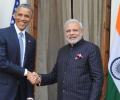
The joint statement issued after Prime Minister Narendra Modi and President Barack Obama's first-ever summit is high on intent and ambition. Notably missing from the statement is India's refusal to be America's partner in its war against ISIS.

He had come in search of jobs in America to rescue his presidency and India failed him in more ways than one, observes Ambassador T P Sreenivasan.

Modi's visit to Spain will be first visit by an Indian prime minister since 1988.

'Modi's investment in the relationship with Washington is the biggest deliverable of this visit. He means business and that's fantastic!'

India has not made the giant leap that was needed.

'The biggest takeaway is that the US-India relationship, which has sputtered a bit in recent months, enjoyed a big boost.'

'This novel format of diplomacy -- the informal summit -- will not only facilitate bilateral communication and reduce miscalculations at the very top level of the two governments, but possibly open the space for China and India to speak in one voice on various issues of mutual concern,' note Feng Renjie and Ding Kun Lei

Reflecting growing congruence in ties, India and Sri Lanka on Tuesday held extensive talks on sticky fishermen issue, ensuring justice to Tamils and ways to deepen trade and defence engagements besides resolving to intensify cooperation in combating terror and securing the maritime neighbourhood.
Another crucial power group, the US legislative Congress, is increasing pressure for closer ties between Washington and New Delhi.

'The Indian Navy has sufficient combat power in areas of interest to India that can quickly scale up operations if the need arises.' 'This includes all the choke points leading into the Indian Ocean as also areas within.'

The Sheikh Hasina-Narendra Modi summit put India-Bangladesh ties on a firmer pitch. Brigadier S K Chatterji (retd) takes stock.

'In India, China's capacities to conduct new types of warfare is critically underestimated,' says Claude Arpi.

'It is in the interest of both sides that the visit of the US President is seen as being successful. Both sides have invested considerable political capital in it. This rapid exchange of visits and the decisions taken have to be justified, beyond the symbolism, which is no doubt important in itself. This opportunity to impart a fresh momentum to ties should not be missed,' says former foreign secretary Kanwal Sibal.

'Progress demands regular senior-level attention from American leaders.' 'A leaders' summit is great, but we need sustained engagement to continue to forge new agreements and find new areas of cooperation.'

Both have been robustly muscular leaders who began as immensely charismatic politicians conveying an impression that they were makers of history, raring to go. Both have been hyperactive on the world stage. But in the final analysis, Abe is departing on a sombre note, unceremoniously and apologetically, observes Ambassador M K Bhadrakumar.

A framework agreement on Jaitapur Nuclear Power Project (JNPP) is expected to be signed between the two sides during the visit.

'2020 will show whether India's troubled domestic economic and political house reveals a mismatch in their strategic association or whether closer strategic ties are yet possible,' says Anita Inder Singh.

'India does not wish to remain silent in improving its strategic space so that its leverage to counter China's expansionist designs is maintained, besides enabling it to play a responsible role from a position of strength for peace and stability in Asia,' points out Dr Rajaram Panda.

'She must first change the Rules of Business 1961 that makes the defence secretary and not the defence minister responsible for the defence of the country!' says Colonel Anil A Athale (retd.)
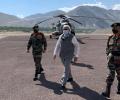
As the China factor enters the body politic of India with greater potency, its consequences will certainly be far-reaching, note Harsh V Pant and Vinay Kaura.

"It is a reflection of the bipartisan support in the US to the relationship with India. It is also a reflection of the value people attach to this relationship," Singh said.

Juster, 62, is an old India hand who played a key role in the landmark Indo-US civil nuclear deal.

It was the 12th day in a row that US military planes have approached the mainland coast, the report said.

Indian-origin technology executives Jayshree Ullal and Neerja Sethi have made it to the Forbes list of America's 60 richest self-made women, with 21-year-old reality TV star and entrepreneur Kylie Jenner the youngest to be featured in the power list.

The two sides inked nearly two dozen pacts in key areas of defence and civil nuclear cooperation after "productive" talks between Modi and Bangladesh Prime Minister Sheikh Hasina in the nation's capital.

'This is the first time that the Americans have agreed to refer to "cross-border terrorist attacks" in a joint statement.' 'No wonder Pakistan has called the joint statement "singularly unhelpful" and has blasted it, and its all-weather friend China has applauded Pakistan's frontline role in combating terrorism,' points out former foreign secretary Ambassador Kanwal Sibal.

The two leaders enjoyed the sunshine with a walk in the grounds of Schloss Meseberg, an 18th century Baroque castle in the Brandenburg district of Germany.

United States Defense Secretary Chuck Hagel will visit New Delhi next week during which he will hold talks with his counterpart Arun Jaitley and other top officials, aimed at "nurturing" ties with India after the formation of the new government, a top Pentagon official has said.

'The Chinese made their point repeatedly after August 5. They backed Pakistan more overtly than in the past.' 'Kashmir is not completely off their radar. But in order to keep the atmosphere surrounding the Chennai meeting, they did not discuss Kashmir.'

The visit of Park Geun-Hye to India, though a symbolic one, will certainly give a further impetus to the strategic partnership between the two countries says Rup Narayan Das.

'The Senators were playing safe, not angering either the pro-India lobby or the pro-Pakistan lobby, but perhaps more importantly, the military-industrial complex -- the most powerful lobby of all -- which the majority of Senators are beholden to in terms of largesse to their campaign coffers.'

As the pandemic unfolded, the India-China relationship has come under severe stress. To restore normalcy, agreements between the two countries must be respected scrupulously in their entirety. Where the Line of Actual Control is concerned, any attempt to unilaterally change the status quo is unacceptable, declares External Affairs Minister Dr Subrahmanyam Jaishankar.
Moving ahead with their new mantra -- Chalein Saath Saath: Forward Together We Go -- Prime Minister Narendra Modi and United States President Barack Obama on Tuesday vowed to deepen cooperation in every sector for the benefit of global stability and people's livelihoods over the next ten years.

PM Modi seems to be gradually ending India's strategic ambiguity

Offering lucrative incentives, Telecom Minister Ravi Shankar Prasad on Sunday invited US technology companies to start manufacturing in India, for meeting domestic needs and exports, under the 'Make In India' initiative.

Israeli President Reuven Rivlin arrived on Monday on an eight-day visit to India, the first by any Israeli President in nearly two decades.

Possible US envoy says India must get assurance against China.
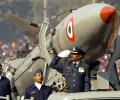
While we have to hiss loudly and do the lunging bit to keep our foes on their toes, that's only a tactical matter. What is the strategic goal? What is the end game? In my opinion, there is only one possible end game: the unwinding of Pakistan into several pieces: Balochistan, Sind, Balawaristan (Gilgit, Baltistan, the rest of PoK), the Pashtun area Khyber Pakhtunwa which will merge with Afghanistan, and the rump Punjab, says Rajeev Srinivasan.

Investment in market leaders with a safety-first approach could yield reasonable returns across sectors.
